
Few things can confuse people moving to Spain more than the different Spanish police forces that exist throughout the country – each of which wears a different uniform and each of which has a different ambit of operation from the other force!
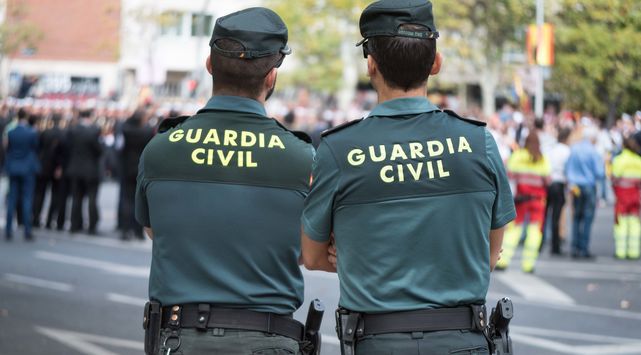
Of course, most people can recognise the Guardia Civil in their green uniforms and (when on ceremonial duty) black tri-corner hats.
However, who are the other police and what do they do?
The truth is that the Spanish police is essentially composed of three forces: the Guardia Civil, the Policia Nacional and the Policia Local.
Some regions though have their own police forces – all of which, in these areas, are in the place of the Policia Nacional.
The three main forces are:
1. Guardia Civil.
To all intents and purposes, the Guardia Civil is a conventional police force who operate in exactly the same way as the police of any other modern European country. They have the resources, powers and facilities of a normal police force and are generally admired within Spain for their high level of discipline and professionalism. Whilst they are a military force (with military ranks) in peacetime they act under the civil authority and have no extraordinary powers.
Importantly, the remit of the Guardia Civil is to police rural areas and towns under around 20,000 people. So, they do not operate in urban areas with a population of approximately 20,000 people. If you suffer a crime or you need police help in a rural area of Spain then it is to the Guardia Civil to whom you must turn – and who will attend to the investigation of any problem.
*Update January 2020. In fact, we have been corrected on the above point. I post here. “The law of Spanish security forces does NOT establish a maximum number of inhabitants so that a population is the responsibility of the Civil Guard. The law establishes that the provincial capitals and certain nuclei that the Government determines will be the responsibility of the National Police, while the rest of the national territory and sea will be the responsibility of the Civil Guard. Therefore, according to the law, the Civil Guard operates both in rural and urban areas outside the provincial capitals.
There are numerous urban areas of 50,000, 80,000 inhabitants or capital outskirts where they work. Examples of these urban areas with more than 20,000 inhabitants in which the Civil Guard operates are Las Rozas, Torrevieja, Mijas, Roquetas, Chiclana, Santa Pola, San Vicente del Raspeig, Majadahonda, Águilas, Mazarron, Rivas, Castro Urdiales, Calvia. Some of them touch the 100,000 inhabitants. ” We stand corrected and are very grateful to those who read our website.
2. Policia Nacional.
The Policia Nacional are normally dressed in black uniforms with white shirts but they can be seen also wearing blue, military-style uniforms. Like the Guardia Civil, they are a conventional police force – albeit that they are a completely civil force with civil (rather than military) ranks. It is to them that you must go if you suffer a crime or need police help within an urban area .

3. Policia Local.
Finally, there is the Policia Local. This is a force which is recruited, funded and controlled by local town halls and that is responsible to the elected Mayor. The Policia Local wear blue uniforms with white shirts and respond to minor crimes.
Mostly the Policia Local deal with local authority enforcement matters, together with urban (city, town or village) traffic control and any associated violations. Crimes are not investigated and any serious matter is immediately handed over to either the Guardia Civil or Policia Nacional – as appropriate to the demographic area. Almost all Spanish police are armed although occasionally this is not the case with village Policia Local.

Don´t forget the wonderful N332 group of Guardia Civil trying to make our roads safer. See their facebook page N332 and website http://www.n332.es.
If you are in Spain and you need the police, here are their telephone numbers:
For general emergencies: 112
To report a crime : 902 102 112
Guardia Civil: 062
Policia Nacional: 091
Policia Local: 092


2 Comments
Un policía español
Hay un error en el artículo, cuando dice que: “Es importante destacar que el cometido de la Guardia Civil es vigilar las zonas rurales y pueblos de menos de 20,000 personas. Por lo tanto, no operan en áreas urbanas con una población de aproximadamente 20,000 personas”.
Ese dato es erróneo. La ley de fuerzas de seguridad española NO establece un número máximo de habitantes para que una población sea competencia de la Guardia Civil. La ley establece que las capitales de provincia y ciertos núcleos que el Gobierno determine serán competencia de la Policía Nacional, mientras que el resto del territorio nacional y mar será competencia de la Guardia Civil. Por lo que conforme a la ley, la Guardia Civil opera tanto en zonas rurales como en zonas urbanas fuera de las capitales de provincia.
Son numerosas las zonas urbanas de 50.000, 80.000 habitantes o de extrarradios de capitales en las que trabaja. Ejemplos de estas áreas urbanas de más de 20.000 habitantes en las que opera la Guardia Civil son Las Rozas, Torrevieja, Mijas, Roquetas, Chiclana, Santa Pola, San Vicente del Raspeig, Majadahonda, Águilas, Mazarron, Rivas, Castro Urdiales, Calvia, Vecindario. .. Algunas de ellas rozan los 100.000 hantantes.